


 PLATFORM UPDATE:


Evaluation of Mn2+ sulfonylcalixarene complex-based materials for oxygen sensing

Abstract
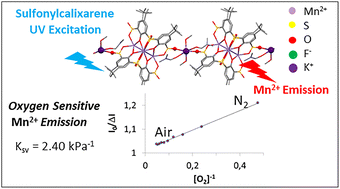
Complexes based on Mn2+ ions and the sulfonylcalixarene (ThiaSO2) macrocycle are being studied as oxygen sensors. The anionic complex [Mn4(ThiaSO2)2F]− exhibits oxygen-sensitive photoluminescent properties. Two counter anions, potassium (K+) or tetrabutylammonium (TBA+) cations, are used to obtain large crystals consisting of assemblies of anionic tetranuclear complexes, using a solvothermal process. A method for obtaining small particles from large crystals is proposed, based on dissolution in dimethylformamide and reprecipitation. This transformation of crystals into particles leads to a structural and textural reorganization that greatly enhances oxygen reactivity. Photoluminescence measurements are performed under controlled oxygen concentration and very good sensitivity to oxygen is observed in both particles, which highlights the enormous impact of structure and texture on luminescent properties. Particles assembled with potassium cations are highly sensitive to oxygen between 0 and 10%. Particles assembled with TBA cations have lower oxygen sensitivity but are more consistent in the 0–20% range, which proves that structural effects finely modulate the oxygen sensitivity. Particle shaping tests are carried out in two polymer matrices, polystyrene (PS) and polyisobutyl methacrylate (PIBMA), which show that the supported particles have retained their properties and that the oxygen response dynamics are very fast. These complexes, which are much more economical than noble metal complexes, are therefore very promising candidates for oxygen detection.
 Please wait while we load your content...


