


 PLATFORM UPDATE:


Tuned X-ray-to-visible light conversion via a chromophore doping strategy for enhanced scintillation performance

Abstract
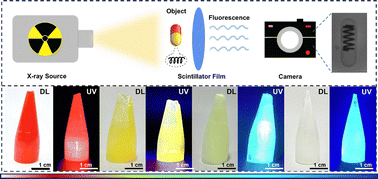
Organic scintillators hold potential for radiation imaging due to their ultrafast decay and low cost. However, their low atomic numbers result in poor X-ray absorption and exciton utilization, thereby degrading performance. To address these challenges, this study proposes a crystal design strategy based on host–guest doping (doping concentration: 0.1 wt%). Trans-stilbene (TSB) was selected as the host molecule, while diindenoperylene (DIP), perylene (PER), 2,6-diphenylanthracene (2,6-DPA), and 9,10-diphenylanthracene (9,10-DPA) were employed as the guest molecules to form a series of organic host–guest systems. The results indicate that introducing guest molecules with phenyl chromophores featuring specific energy levels and fluorescence properties can enhance the radiative utilization efficiency of singlet excitons. Furthermore, the radioluminescence integrated area of organic host–guest systems was improved by approximately 30-fold while maintaining nanosecond-scale ultrafast decay, enabling broadly tunable emission across 435–631 nm. This work presents a novel design strategy and a feasible pathway for developing high-performance organic scintillators that combine tunable luminescence with ultrafast decay characteristics.
- This article is part of the themed collection: Journal of Materials Chemistry C HOT Papers
 Please wait while we load your content...


