


 PLATFORM UPDATE:


Solution-processable double-boron-nitrogen-doped deep blue multi-resonance thermally activated delayed fluorescence materials

Abstract
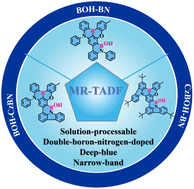
Here, we present a series of narrowband deep-blue EL emitters achieved by incorporating two functionally distinct boron (B) atoms into a molecular framework. We successfully obtained three proof-of-concept emitters, BOH-BN, BOH-CzBN, and CzBOH-BN, with excellent solubility in common solvents. One B atom forms a rigid cyclic structure with the ortho-nitrogen (N) and oxygen (O) atoms via three C–B bonds, creating a structural unit with notable multiple-resonance (MR) properties, whose primary function is to narrow the molecular emission peak. The other B atom interacts with neighboring hydroxyl (OH) and N atoms to form a six-membered ring structure that lacks MR features but increases monomolecular rigidity, preventing long-range conjugation, which helps maintain the material's emission in the deep blue region and effectively suppresses non-radiative decay. BOH-BN, BOH-CzBN, and CzBOH-BN all exhibited very narrow, deep-blue emission with photoluminescence (PL) peaks at 444 nm, 441 nm, and 458 nm, respectively, and FWHM values of 20 nm, 17 nm, and 19 nm. Notably, the CIE color coordinates of BOH-BN (0.145, 0.038) and BOH-CzBN (0.150, 0.036) are very close to the BT.2020 standard indicating high color purity and a good match with UHD display color gamuts. The corresponding deep-blue OLEDs based on BOH-BN, BOH-CzBN, and CzBOH-BN exhibit peak external quantum efficiencies (EQEs) exceeding 5%, indicating that this series of materials has the potential to achieve high-performance EL properties via solution processing.
 Please wait while we load your content...


