


 PLATFORM UPDATE:


Shifting shades: a polymorph-driven luminescence modulation in a dual-state emissive organic luminophore
 b
Ahmad
Husain,
f
Sumit Kumar
Panja,
*d
Manas K.
Panda
*e
and
Ganesh Chandra
Nandi
*a
b
Ahmad
Husain,
f
Sumit Kumar
Panja,
*d
Manas K.
Panda
*e
and
Ganesh Chandra
Nandi
*a
Abstract
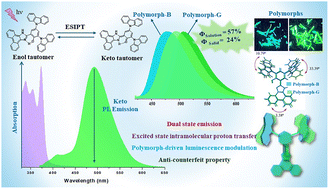
Herein, we report a dual-state emissive (DSE) luminophore, DCZHPI, bearing a phenanthroimidazole (PI) core with carbazole substitution. Two concomitant polymorphs (DCZHPI-B and DCZHPI-G) of DCZHPI emerge upon slow evaporation from the MeOH/DCM system, each displaying a butterfly-like molecular architecture. These two polymorphs exhibit distinct luminescence properties due to packing structure variations. DCZHPI exhibits emission from the keto tautomer following an ESIPT mechanism with a large Stokes shift (∼120 nm) and high photoluminescence quantum yield (Φsol = 57% and Φsolid = 2.5–24%). The photophysical properties and ESIPT have been investigated meticulously using experimental and theoretical calculations. Utilizing the photoswitachable properties of DCZHPI, we have demonstrated its application in confidential encoding and anti-counterfeiting writing/printing. We believe that all these properties make DCZHPI a prominent organic luminescent material for promising applications in bioimaging, chemosensing, data encryption, and organic optoelectronic systems.
 Please wait while we load your content...


