


 PLATFORM UPDATE:


Reversible hydration-induced ionic conductivity switching accompanied by large desorption enthalpy in sodium salts of 1,2,3-triazole-fused p-benzoquinone
 *ab
Tomoyuki
Akutagawa
*ab
*ab
Tomoyuki
Akutagawa
*ab
Abstract
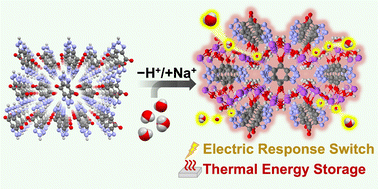
Stimuli-responsive molecular solids that exhibit multifunctionality are highly sought after for advanced sensing and thermal energy storage applications. However, introducing guest molecules such as water into dense π-conjugated crystal lattices reversibly, while simultaneously achieving significant property modulation, remains a challenge. Herein, we demonstrate that the stepwise substitution of protons with sodium ions in 1,2,3-triazole-fused p-benzoquinone (H2BTBQ) enables the control of flexibility and hydrophilicity of the crystal lattice, leading to reversible hydration-induced functionality switching. While the neutral form H2BTBQ is anhydrous and insulating, the sodium salts NaHBTBQ and Na2BTBQ form stable hydrates. Notably, Na2BTBQ exhibits a reversible two-step water sorption behavior involving four water molecules per formula unit. Thermal analyses revealed that the dehydration of Na2BTBQ·4H2O is accompanied by a large endothermic enthalpy change (50.45 and 57.05 kJ (mol-H2O)−1), which significantly exceeds the heat of vaporization of bulk water, indicating its potential as a solid-state cooling material. Furthermore, alternating current (AC) impedance spectroscopy demonstrated that water adsorption triggers a drastic switching of ionic conductivity in Na2BTBQ, originating from hydrated sodium ion migration. This work provides a crystal engineering strategy to realize functional materials combining large latent heat storage and dielectric switching via reversible hydration in dense organic salt crystals.
 Please wait while we load your content...


