


 PLATFORM UPDATE:


Tunable intrinsic magnetism in 2D Mo2B2via double-transition-metal engineering under an electric field and hole doping

Abstract
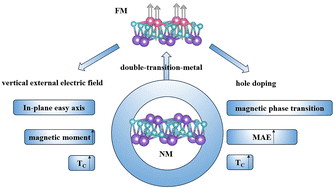
To advance the exploration of two-dimensional (2D) magnetic materials for spintronic applications, we propose a family of double-transition-metal (DTM) boride monolayers, MMoB2 (M = V, Cr, Mn, Fe, Co, Ni), and systematically investigate their magnetic behaviors using first-principles calculations combined with Monte Carlo simulations. Our study demonstrates that intrinsic magnetism is achieved in MMoB2 (M = V, Cr, Mn, Fe, Co) monolayers. The magnetic moments in MMoB2 (M = V, Cr, Mn, Fe, Co) monolayers primarily originate from the exchange splitting of the M atom d-orbitals. MMoB2 (M = V, Cr, Mn) monolayers show an out-of-plane easy magnetization axis, while MMoB2 (M = Fe, Co) monolayers exhibit an in-plane easy axis. The calculated Curie temperatures (TC) of MMoB2 (M = V, Cr, Mn, Fe) monolayers are well above room temperature, with the CrMoB2 monolayer reaching as high as 1174 K, indicating their great potential for practical spintronic applications. In addition, both vertical electric fields and hole doping effectively manipulate the magnetic behaviors of MMoB2 (M = V, Cr, Mn, Fe, Co) monolayers. Under these external stimuli, the magnetic moments, magnetic anisotropy energies (MAE) and TC of MMoB2 (M = V, Cr, Mn, Fe, Co) monolayers are further enhanced.
 Please wait while we load your content...


