


 PLATFORM UPDATE:


Enhancing photovoltaic performance by modulating fractal dimensions of non-fullerene acceptors

Abstract
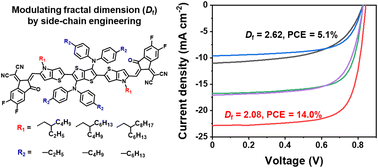
The morphology of the active layer has a significant impact on the performance of organic solar cells (OSCs). However, building a reliable and quantifiable relationship between the molecular structure design and the film morphology is hindered by the complex composition and interactions in the bulk-heterojunction blend. In this study, we designed and synthesized a series of non-fullerene acceptors, TTTPs, by precisely modulating the side chains at distinct positions to systematically investigate the influence of side-chain length on the blend morphology. To quantify the relation, we used fractal dimension (Df) to assess the connectivity between the inter-acceptor domains and analyze the phase separation scale of the blend film. Among the TTTP series, TTTP2 with a butyl chain on the diphenylamine and a branched 2-butyloctyl chain on the thieno[3,2-b]pyrrole exhibited a Df value of 2.08 and moderate domain sizes, leading to well-extended acceptor crystalline domains dispersed within a matrix of donor/acceptor intermixed amorphous domains, ensuring adequate donor/acceptor interfaces for charge separation and continuous channels for carrier transport. Other TTTP acceptors with varied side-chain lengths exhibited larger Df values, characterized by more agglomerated crystalline domains. The optimal morphology in PBDB-T:TTTP2 is beneficial for balanced carrier transport, reduced charge recombination, and minimized voltage loss. As a result, OSCs based on PBDB-T:TTTP2 achieved a champion power conversion efficiency of 14.0%, which was much higher than those of its counterparts, ranging from 5.1% to 10.0%.
- This article is part of the themed collection: Journal of Materials Chemistry C HOT Papers
 Please wait while we load your content...


