


 PLATFORM UPDATE:


Efficient long-wavelength-excited triplet–triplet annihilation upconversion with phenyl-diketopyrrolopyrroles as the annihilators
 *b
and
Ling
Huang
*a
*b
and
Ling
Huang
*a
Abstract
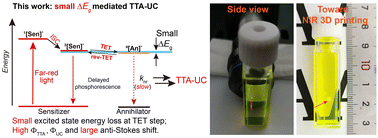
Long-wavelength-excited triplet–triplet annihilation upconversion (TTA-UC) holds significant promise for applications in photoredox catalysis, volumetric three-dimensional printing, and bioimaging. However, enhancing the upconversion quantum yield (ΦUC; theoretical upper limit: 50%) of TTA-UCs remains a persistent challenge. In long-wavelength-excited TTA-UC, the low-lying triplet excited state (T1) energy levels of both the photosensitizer and annihilator give rise to rapid intrinsic nonradiative transitions, which impede intermolecular triplet energy transfer and TTA processes. To tackle this problem, we precisely tuned the molecular dihedral angle of a diketopyrrolopyrrole (DPP)-based annihilators, aligning its T1 energy level with that of the sensitizer. This small-energy-gap design effectively maintains a relatively high T1 energy level for the annihilator, reduces excited-state energy loss during triplet–triplet energy transfer (TET), and mitigates nonradiative transitions of the annihilator. As a result, we achieved an outstanding ΦUC of 8.6% along with a notable anti-Stokes shift of 0.55 eV. Using this efficient TTA-UC pair, we successfully demonstrated spatially confined photopolymerization under 721 nm irradiation at an intensity of 5.7 W cm−2. This strategy offers a new approach to tailor the triplet-state properties of annihilators, thereby boosting the performance of long-wavelength-excited TTA-UC and broadening the applications of photon upconversion in chemistry, biology, and materials science.
 Please wait while we load your content...


