


 PLATFORM UPDATE:


The impact of core-substitution on the sequential reduction-induced open-shell structures in napthalenediimides

Abstract
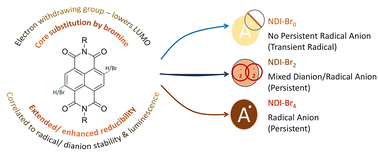
n-Type doping in organic semiconductors has emerged as a powerful strategy to modulate electrical conductance. Identifying the structural features that enable efficient chemical doping is therefore essential for rational molecular design. In this work, we establish a clear structure–property correlation in naphthalenediimide (NDI)-based n-channel materials through systematic structural modification, from unsubstituted NDI-Br0 to heterogeneously reduced NDI-Br2 (yielding a mixture of species), and finally to the cleanly and homogeneously generated NDI-Br4 radical anion. The formation of the NDI-Br4 doped system arises from a synergistic mechanism: the strong electron-withdrawing inductive effect of the four bromine atoms provides the necessary thermodynamic driving force for reduction (validated by spectro-electrochemistry), while their active involvement in spin and charge delocalization—confirmed by FT-IR, XPS, and DFT analyses—ensures thermodynamic and kinetic stabilization of the open-shell product. This precise chemical control translates directly to functional outcomes, enabling a “fluorescence turn-on” behaviour by fundamentally reconfiguring the molecule's de-excitation pathways. The strong correlation between the persistent open-shell character of the NDI-Br4 radical and its photophysical purity—as a single, bright emitter at 589 nm—is definitive. Overall, this study delivers a stable, air-persistent, and emissive radical platform for n-type semiconductors and next-generation sensors, while establishing key molecular design principles for achieving controlled open-shell architectures.
- This article is part of the themed collection: Joint collection on photoluminescent organic materials
 Please wait while we load your content...


