Advances in Fluorescence-Based Point-of-Care Diagnostics: Probes, Nanostructures and Integrated Systems

Abstract

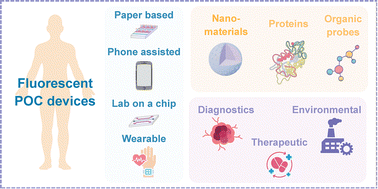
Fluorescence-based point-of-care (POC) technologies are rapidly evolving through advances in materials chemistry. This review provides a comprehensive overview of fluorescent molecular probes, proteins, hybrid nanostructures, MOFs, silica platforms, carbon dots, and upconverting nanoparticles engineered for portable diagnostics. We highlight fundamental photophysical mechanisms, design strategies for improving brightness, stability, and multiplexing, and the integration of fluorescent materials with microfluidics, wearable interfaces, and smartphone readouts. Current limitations, translational challenges, and emerging trends, including AI-enabled data analysis and next-generation NIR and AIE fluorophores, are discussed. Together, these insights outline how materials innovation is driving the next generation of high-performance POC sensing systems.
Article information

Article type
Review Article
Submitted
27 Nov 2025
Accepted
12 Feb 2026
First published
14 Feb 2026
This article is Open Access
Creative Commons BY-NC license

J. Mater. Chem. C, 2026, Accepted Manuscript

Advances in Fluorescence-Based Point-of-Care Diagnostics: Probes, Nanostructures and Integrated Systems

M. Cedrún-Morales, E. Soprano, G. Vanoni, A. Chandra, H. Iuele, F. Colella, S. Forciniti, V. Onesto, G. Grasso, G. Gigli and L. L. del Mercato, J. Mater. Chem. C, 2026, Accepted Manuscript , DOI: 10.1039/D5TC04199F

This article is licensed under a Creative Commons Attribution-NonCommercial 3.0 Unported Licence. You can use material from this article in other publications, without requesting further permission from the RSC, provided that the correct acknowledgement is given and it is not used for commercial purposes.

To request permission to reproduce material from this article in a commercial publication, please go to the Copyright Clearance Center request page.

If you are an author contributing to an RSC publication, you do not need to request permission provided correct acknowledgement is given.

If you are the author of this article, you do not need to request permission to reproduce figures and diagrams provided correct acknowledgement is given. If you want to reproduce the whole article in a third-party commercial publication (excluding your thesis/dissertation for which permission is not required) please go to the Copyright Clearance Center request page.

Read more about how to correctly acknowledge RSC content.

Social activity

Spotlight

Advertisements