


 PLATFORM UPDATE:


Achieving efficient near-ultraviolet HLCT emitters via isomer engineering
 *c
and
Ping
Lu
*a
*c
and
Ping
Lu
*a
Abstract
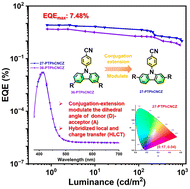
High-efficiency organic emitters that meet the increasing demand of BT. 2020 for vivid color reproduction are of significant importance for organic light-emitting diodes (OLEDs). In this work, we prepare a series of donor (D)–acceptor (A) type near-ultraviolet (NUV) emitters, 27-TPhCNCZ, 27-PTPhCNCZ, 36-TPhCNCZ, and 36-PTPhCNCZ, based on benzonitrile, phenyl, and carbazole groups. In toluene solution, 27-TPhCNCZ, 27-PTPhCNCZ, 36-TPhCNCZ, and 36-PTPhCNCZ exhibit main emission peaks at 374, 389, 384, and 390 nm in the NUV region with high PLQYs over 82%. By varying the substitution site on carbazole (2,7/3,6-positions), the dihedral angles (θ1/θ3) between carbazole and neighboring phenyl units and θ2 between carbazole and benzonitrile are accordingly modulated. Among them, 27-PTPhCNCZ exhibits LE-dominant hybridized local and charge transfer (HLCT) characteristics compared to the CT-dominant excited states in 27-TPhCNCZ, 36-TPhCNCZ, and 36-PTPhCNCZ. The device based on 27-PTPhCNCZ realizes the best device performance with an electroluminescence peak at 408 nm, a maximum external quantum efficiency of 7.48%, and CIE coordinates of (0.17, 0.04), matching well with the BT.2020 standard. This work provides reliable guidance for the development of high-efficiency NUV emitters.
 Please wait while we load your content...


