


 PLATFORM UPDATE:


Salt complexation drives liquid crystalline self-assembly in crown ether–amino acid hybrids†

Abstract
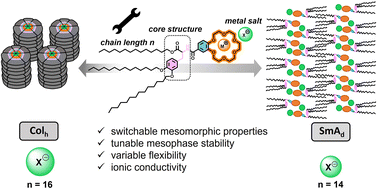
Crown ether–amino acid hybrids represent a promising class of amphiphilic molecules combining ion recognition with self-assembly capabilities. Despite extensive studies on their binding properties, the influence of inorganic salt complexation on their liquid crystalline behaviour remains underexplored. Here we synthesized amphiphilic [18]-crown-6 derivatives of L-dihydroxyphenylalanine and tetrahydroisoquinoline analogues, systematically investigating the effects of alkyl chain length and salt type on mesophase formation. Complexation with various salts induced liquid crystalline phases, transitioning from smectic A to columnar hexagonal structures as anion size and alkyl chain length increased. Structural analyses and electron density mapping revealed assembly into charged superdiscs forming columnar stacks with tunable ion channels. Broadband dielectric spectroscopy highlighted differences in molecular mobility and conductivity linked to molecular design. These findings establish salt complexation as a key strategy to control self-assembly and ion transport in crown ether–amino acid hybrids, advancing their potential in responsive soft materials and ion-conductive applications.
 Please wait while we load your content...


