


 PLATFORM UPDATE:


Direct ink writing of silver nanowire-based flexible temperature sensors on fabric for wearable thermal monitoring

Abstract
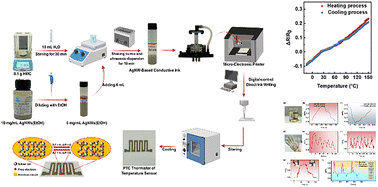
We fabricate high-sensitivity flexible temperature sensors by direct ink writing of silver nanowires (AgNWs) on fabric. Optimized printing parameters (0.5 mm spacing, 6 layers) yield uniform conductivity (9.71 ± 0.21 Ω □−1) with 130 °C sintering stabilization. The sensors exhibit 0.115–0.315% °C−1 temperature coefficients and negligible hysteresis (ΔH(T) < 1.32) across −15–180 °C, enabled by phonon-boundary scattering in nanoscale networks. They demonstrate rapid response (7–102 s) constrained by textile thermal diffusivity, while photothermal conversion enables millisecond-resolution radiation detection (t90 = 25.6 ± 0.1 s). Ambient tests confirm ±1.0 °C precision unaffected by humidity (20–80% RH) and airflow, with predictable compressive strain offsets (δT ≈ −2.1 °C at 10 kPa) and bending offsets (δT ≈ 2.5 °C at 33.33%). Validated in real-world scenarios including physiological motion monitoring (±2.0 °C stability), this textile-integrated platform overcomes flexibility-precision trade-offs for wearable healthcare and industrial sensing applications. This study addresses the limitations of AgNWs in temperature sensor applications, significantly advancing their practical implementation.
 Please wait while we load your content...


