


 PLATFORM UPDATE:


An energy-efficient NbOx/ZrO2 bilayer memristor enabling low-voltage multilevel switching for neuromorphic computing

Abstract
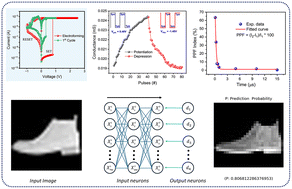
The rapid growth of artificial intelligence (AI) and edge computing has intensified an urgent demand for energy-efficient hardware capable of mimicking the parallel processing and adaptive learning functions of the human brain. Memristive devices have emerged as promising candidates due to their ability to emulate synaptic behavior while offering scalability, non-volatility, and low power consumption. Despite significant progress, achieving stable low-voltage operation together with long-term reliability remains a key challenge. Here, we report the fabrication and comprehensive evaluation of a Pt/NbOx/ZrO2/Ag bilayer memristor that combines low-voltage switching with high reliability. Structural analyses reveal a well-defined NbOx/ZrO2 interface, smooth surface morphology, and clear chemical partitioning, providing a robust platform for controlled filament evolution. The device exhibits reliable resistive switching with a SET voltage of ∼0.23 V, excellent endurance, stable data retention, and a large ON/OFF ratio exceeding 104. Tunable multilevel conductance states are achieved through compliance current modulation, as confirmed by the stable and reproducible switching characteristics. Beyond memory functionality, the bilayer architecture enables accurate emulation of key synaptic behaviors, including long-term potentiation (LTP), long-term depression (LTD), and paired-pulse facilitation (PPF). When implemented in an artificial neural network, the device achieves a recognition accuracy of ∼80% on the Fashion-MNIST dataset, highlighting its potential for neuromorphic computing. These results establish the NbOx/ZrO2 bilayer memristor as a promising materials-engineered platform for next-generation non-volatile memory and brain-inspired computing systems with enhanced energy efficiency and scalability.
 Please wait while we load your content...


