


 PLATFORM UPDATE:


Orientation control of Cu3(HHTP)2 MOF films using a dual working electrode electrochemical synthesis method

Abstract
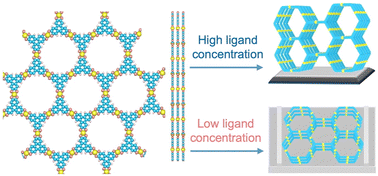
Materials that consist of stacked two-dimensional electronically conductive metal–organic frameworks (2D-cMOFs) have potential for integration into novel electronic devices. These layered materials have crystal structures and charge transport properties that are highly anisotropic. For effective use as functional device materials it is therefore important to achieve control over the crystallographic orientation of the films and their growth mechanisms. Here we report an electrochemical method to synthesise Cu3(HHTP)2 films in situ on ITO glass with controllable film orientation and thickness using a dual working electrode setup. By adjusting the ligand concentration in the electrolyte, different Cun(HHTP)m complexes form, which interact differently with the electrode upon which the MOF is grown. This leads to the consistent formation of edge-on or face-on oriented MOF films. For high ligand concentrations the 2D layers grow perpendicular to the electrode substrate, whereas for low ligand concentrations the layers are parallel to the substrate. Extensive characterisation and theoretical simulations of this material system lead to the conclusion that growth of the different MOF orientations is a result of the electric dipoles on the Cun(HHTP)m complexes. Cu(HHTP) and Cu2(HHTP) complexes are created under high ligand concentration conditions and have electric dipoles that result in edge-on nucleation due to electrostatic interactions with the potential on the electrode. Under low ligand concentrations Cu3(HHTP) complexes are formed that do not have a dipole and nucleate face-on via van der Waals interactions.
- This article is part of the themed collection: Journal of Materials Chemistry C HOT Papers
 Please wait while we load your content...


