


 PLATFORM UPDATE:


Effect of deuteration on exciplex dynamics in organic donor–acceptor blends
 *b
and
Chihaya
Adachi
*ac
*b
and
Chihaya
Adachi
*ac
Abstract
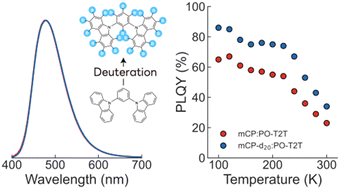
Exciplex systems based on deuterated organic semiconducting molecules provide a promising strategy to enhance the performance of organic light-emitting diodes (OLEDs). Although the enhancement of OLED performance by utilizing a partially deuterated exciplex system has been reported, the impact of deuteration of the organic semiconducting molecule on exciplex dynamics has not been fully characterized. Here, we investigate the impact of deuteration of the electron-donor molecules (mCP-d20 : 1,3-dicarbazole-benzene-d20) on the exciplex dynamics in the mCP-d20 : 2,4,6-tris[3-(diphenylphosphinyl)phenyl]-1,3,5-triazine (PO-T2T) co-deposited films. Compared to the co-deposited films based on undeuterated mCP, the mCP-d20:PO-T2T films exhibited a 1.5-fold increase in photoluminescence quantum yield (PLQY) with prolonged delayed emission lifetime. Temperature-dependent kinetic analyses for electron transition processes revealed that the enhancement of PLQY in the mCP-d20:PO-T2T films originates from the suppression of thermally activated nonradiative decay from the excited charge-transfer triplet state by donor deuteration. Consequently, the OLED based on the deuterated exciplex system demonstrated a higher external quantum efficiency than those employing undeuterated donors.
 Please wait while we load your content...


