


 PLATFORM UPDATE:


Emulating frog's behavior: humidity-driven paired-pulse facilitation and metaplasticity realised in a 1D supramolecular nanofibre based neuromorphic device

Abstract
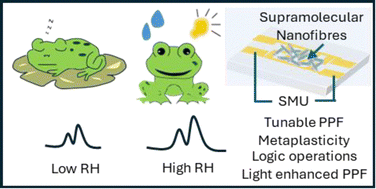
Neuromorphic sensing has emerged as a promising approach for next-generation electronics due to its fast response, ultralow energy consumption, minimized data transfer overhead, and the ability to merge sensing and memory within a single platform. While conventional demonstrations typically rely on coupling a separate sensor with a memristive element, truly adaptive sensing requires both functionalities to be embodied within one device. Environmental factors, particularly humidity, play a critical role in modulating synaptic activity in biological systems, yet this aspect has been largely overlooked in neuromorphic device design. Here, we report a humidity-responsive neuromorphic sensor based on one-dimensional supramolecular nanofibres composed of coronene tetracarboxylate (CS) and dodecyl methyl viologen (DMV). By exploiting humidity-modulated synaptic weight updates, the device successfully emulates a broad range of synaptic functionalities, including paired-pulse facilitation (PPF), metaplasticity, light-enhanced synaptic response, and logic operations. A PPF index as high as 3.5 is achieved by tuning relative humidity, demonstrating multimodal plasticity and adaptive learning. Interestingly, the device behavior parallels the moisture-dependent neural responses of amphibians, such as frogs, whose synaptic activity is tightly regulated by environmental humidity. This bioinspired correlation underscores the significance of incorporating environmental cues into neuromorphic platforms. Our findings highlight the potential of supramolecular nanofibre-based architectures as versatile and highly adaptive neuromorphic sensors, paving the way for brain-inspired technologies capable of integrating environmental responsiveness with efficient signal processing.
- This article is part of the themed collection: Celebrating International Women’s Day 2026: Women in Journal of Materials Chemistry C
 Please wait while we load your content...


