


 PLATFORM UPDATE:


Optimizing the Cu2+ ion and carbon-related defect center ratio in g-C3N4–ZnO:Cu nanocomposites for supercapacitor applications

Abstract
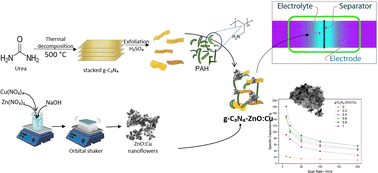
In this work, we synthesised composite materials based on g-C3N4 as a carbon source, and ZnO doped with different Cu ion concentrations (ZnO:Cux, x = 0, 0.2, 0.4, 0.6, 0.8, and 1%) using multiple synthesis approaches. The synthesized g-C3N4–ZnO:Cu nanocomposites were characterised using advanced techniques like X-ray diffraction, scanning and transmission electron microscopy, Fourier transform infrared spectroscopy, and UV-vis adsorption and photoluminescence spectroscopy to evaluate the formation of the composite structure and the role of the dopant in the morpho-structural, optical, and compositional properties. Electron paramagnetic resonance spectroscopy and X-ray photoemission spectroscopy were employed to determine the carbon-related defect structure (VC) of the composite materials, which also revealed the presence of Cu ions in the ZnO lattice with a 2+ oxidation state. Electrochemical measurements, including galvanostatic charge–discharge and cycling stability tests, confirmed superior charge storage capacity, efficient electron transfer, and long-term durability. Notably, the g-C3N4–ZnO:Cu0.8-based supercapacitor device exhibited excellent cycling stability with 110% capacitance retention after 10 000 cycles, along with the highest power (917.81 W kg−1) and energy density (25.24 Wh kg−1), making it a promising candidate for high-performance energy storage applications. The results indicate that an increase in the Cu concentration facilitates charge transport. The Cu-doped ZnO is primarily responsible for the pseudocapacitance mechanism in the supercapacitor device. Increasing the Cu doping concentration facilitates the appearance of redox reactions. However, once a certain dopant threshold is reached, any further increase in the dopant concentration results in a sudden drop in the current response, showing that the Cu2+/VC ratio plays an important role in the charge storage mechanism of the composites. Fine-tuning this ratio, which is a key parameter, has to be taken into account when designing carbon-based/metal oxide composite materials.
 Please wait while we load your content...


