


 PLATFORM UPDATE:


Ferroelectric devices as physical reservoirs: enabling nonlinear dynamics and memory in neuromorphic systems

Abstract
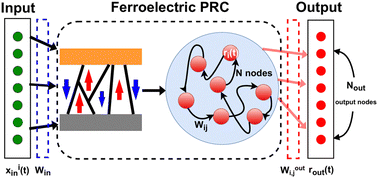
Reservoir computing (RC) provides a training-efficient alternative to recurrent neural networks by fixing recurrent weights and training only a linear readout. In hardware, physical reservoirs harness intrinsic device dynamics to supply the three requisites for temporal computation: nonlinearity, short-term memory, and resulting high-dimensional state richness. This review summarises RC fundamentals and maps device requirements onto materials properties including domain nucleation, hysteresis, depolarisation-driven volatility, and multiscale relaxation. We survey representative ferroelectric platforms, including hafnia-based ferroelectric field-effect transistors (FeFETs), ferroelectric tunnel junctions (FTJs), and ferroelectric thin-film transistors (FeTFTs), together with their antiferroelectric variants. These devices inherently support nonlinear input–state mapping, tunable fading memory, and rich intermediate states. Implementation strategies include multiplexing and single-device reservoirs, evaluated against metrics for memory capacity and energy–latency–accuracy. Emphasis is placed on complementary-metal-oxide–semiconductor compatible HfO2 for scalability, fast switching, and low-voltage operation. Reliability and variability are reframed as resources through interface and defect engineering. Ferroelectrics emerge as energy-efficient reservoirs for robust temporal inference at the edge.
- This article is part of the themed collection: Journal of Materials Chemistry C Recent Review Articles
 Please wait while we load your content...


