


 PLATFORM UPDATE:


Achieving efficient blue room-temperature phosphorescence in cyclized aromatic amides via a hybridized local and charge-transfer state

Abstract
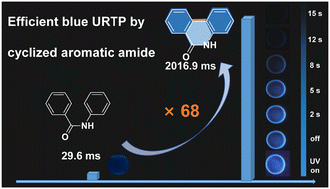
The development of organic blue room-temperature phosphorescence (RTP) materials is challenging, primarily due to the difficulty in simultaneously generating and stabilizing high-energy triplet states. While most reported RTP systems emit in the green or yellow regions, blue-emitting scaffolds remain scarce. Here, we report a series of cyclized aromatic amides (CAAs) that exhibit highly efficient blue RTP in polyvinyl alcohol (PVA) matrices. The optimized CAA demonstrates a phosphorescence lifetime of 2016.9 ms and a quantum yield of 15.6%, representing a 68-fold increase in lifetime and a doubling of efficiency compared to its non-cyclized counterpart. Single-crystal and theoretical analyses reveal that the triplet state of CAAs possesses a hybrid local and charge-transfer (HLCT) character, which is distinct from the predominantly charge-transfer (CT) nature of the non-cyclized analog. The HLCT state maintains a high-energy triplet excited state (T1) suitable for blue emission, while minimizing spin–orbit coupling (SOC) between T1 and the ground state (S0), thereby enabling an ultralong lifetime. Furthermore, the planar rigid scaffold of CAAs, combined with the restrictive PVA matrix, effectively suppresses non-radiative decay, enhancing the overall RTP efficiency. This work establishes CAAs as a promising class of blue phosphors that concurrently achieve high efficiency and an ultralong lifetime, offering a viable design strategy for advanced photonic applications.
- This article is part of the themed collections: Journal of Materials Chemistry C HOT Papers and New Developments in Photofunctional Materials and Transformations
 Please wait while we load your content...


