


 PLATFORM UPDATE:


Engineering the amorphous-to-crystalline transformation, fluorescence enhancement and reversible switching of a cyclobutane derivative inside a polymer film
 a
Ram Singh
Jat,
b
Ch.
Suresh,
a
S. Rajagopala
Reddy,
b
M.
Bhanuchandra
c
and
Chanchayya Gupta
Chandaluri
*a
a
Ram Singh
Jat,
b
Ch.
Suresh,
a
S. Rajagopala
Reddy,
b
M.
Bhanuchandra
c
and
Chanchayya Gupta
Chandaluri
*a
Abstract
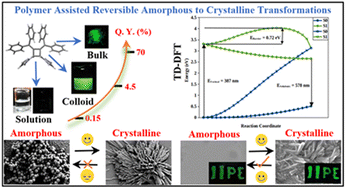
The critical characteristic of molecular materials is the weak intermolecular interactions that determine their self-assembly and impact upon their photophysical attributes. Precise control of molecular self-assembly at the nano/microscale can be used to realize desired material properties, paving the way for the development of innovative functional materials. This study is focused on the controlled assembly of a small molecule (cyclobutane derivative, CB)-based material to obtain amorphous and crystalline phases, followed by a detailed investigation of their optical characteristics. Simple drop-casting and re-precipitation techniques are used to fabricate the amorphous and nano/microcrystalline phases of CB. More significantly, a polymer-assisted, highly reversible amorphous-to-crystalline transformation of CB is demonstrated using solvent fuming techniques. During the transformation from the amorphous to the crystalline phase, an increase in fluorescence quantum yield and a blue shift in the emission wavelength were observed. CB exhibited a high quantum yield of ∼70% and enhanced fluorescence emission, ∼450 times greater in the solid state compared to its solution state. Crystallographic analysis and computational modelling provided insights into the significance of molecular self-assembly and the plausible mechanism underlying the fluorescence emission enhancement in the solid state. This work illustrates a simple and effective method to control molecular self-assembly within the polymer matrix, which can lead to tailored optical properties, offering insights into the design of smart soft materials.
 Please wait while we load your content...


