


 PLATFORM UPDATE:


Stable PbI2-terminated (001) facets drive low-defect anisotropy for high-performance charge transport in MAPbI3 single crystals
 *ab
*ab
Abstract
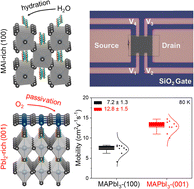
Although crystallographic engineering of perovskite single crystals offers a promising route to optimize optoelectronic performance, the intrinsic charge transport mechanisms governing facet-dependent anisotropy remain poorly understood. Herein, we resolve this issue through comparative analysis of stoichiometry-controlled MAPbI3 single crystals with dominant (100) and (001) facets. The PbI2-terminated (001) facet achieves enhanced atmospheric stability via oxygen-mediated passivation and reduced hydration susceptibility, contrasting sharply with the air-sensitized MAI-dominated (100) surface. Bulk characterization further identifies 18% higher mechanical hardness and 15% lower trap density in (001)-oriented crystals compared to their (100) counterparts. Synergistically, the (001) facet exhibits an 18% elevated ion migration activation energy (0.59 eV) and superior Hall effect mobility (7.3 cm2 V−1 s−1 at 180 K), surpassing (100) by 1.55×. Temperature-dependent field-effect transistors corroborate this anisotropy, yielding a peak mobility of 14.7 cm2 V−1 s−1 for (001) versus 8.3 cm2 V−1 s−1 for (100). Our findings establish crystallographic orientation as a pivotal design parameter, with PbI2-terminated (001) facets offering atomic-scale insights for advancing high-efficiency perovskite optoelectronics.
 Please wait while we load your content...


