


 PLATFORM UPDATE:


Acid-reagent-engineered tunable multicolor carbon dots via solid-phase pyrolysis for advanced information encryption and anti-counterfeiting

Abstract
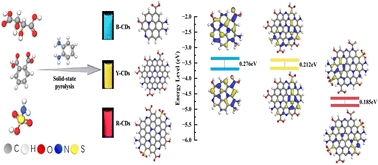
Multicolor fluorescent carbon dots (CDs) have attracted considerable attention because of their excellent application prospects in advanced information encryption and anti-counterfeiting. Herein, we describe a simple solid-phase pyrolysis method that uses o-phenylenediamine (OPD) as the carbon source and exploits the deliberate selection of different solid acids. The resulting CDs, synthesized from tartaric acid (TA), phthalic acid (PA), and sulfamic acid (SA), emit bright blue, yellow, or red fluorescence, and are accordingly designated as B-CDs, Y-CDs, and R-CDs, all of which exhibit excellent optical properties and outstanding photothermal stability. Detailed characterization indicates that the distinct photoluminescence arises from differences in particle size, surface functional groups, and heteroatom (N,S) doping. Density functional theory (DFT) calculations reveal that the emission redshift originates from bandgap narrowing induced by surface functional groups and expanded π-conjugated domains. Total and projected density of states (TDOS/PDOS) analyses further confirm that heteroatom incorporation generates localized states and surface defects, which collectively reduce the bandgap and induce the observed redshift. Furthermore, these multicolor CDs serve as efficient fluorescent inks, demonstrating superior performance in anti-counterfeiting and information encryptions. This study not only offers a new strategy for synthesizing multicolor-emitting CDs, but also underscores their potential in advanced security technologies.
 Please wait while we load your content...


