


 PLATFORM UPDATE:


UVC-induced valence switching in BaFBr:Sm3+ nanoplates

Abstract
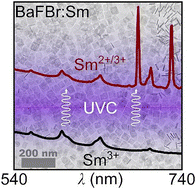
UVC-induced valence switching in nanocrystalline BaFBr:Sm3+ was studied in the context of photoexcitable storage phosphors. Nanocrystals were synthesized via hot-injection thermolysis of metal bromodifluoroacetates and consisted of square plates with average dimensions 34.4 nm (edge) × 4.9 nm (thickness); polydispersities in both dimensions were less than 10%. Nanoplates were found to undergo partial reduction upon exposure to UVC radiation of wavelength equal to 185 nm to yield BaFBr codoped with Sm3+ and Sm2+. Luminescence studies were conducted to probe a number of aspects of this photochemical reaction, including extent, kinetics, reversibility, and stability of photogenerated Sm2+ ions. Photoreduction extent depended on atmosphere (air vs. vacuum) and sample treatment (as-prepared vs. preheated), revealing the presence of photoactive centers at or near the surface of the nanoplates. Photoreduction kinetics was rationalized invoking a bimodal distribution of photoactive centers in which electron-trapping Sm3+ ions were distinguished on the basis of their distance to hole-trapping oxide defects. Valence switching was found to be reversible. Slow ionization of Sm2+ occurred in the dark via tunneling. Additionally, Sm2+ could be photoionized using light of appropriate wavelength via injection into the host's conduction band. Wavelength-dependent photoionization studies enabled construction of a host-referred binding energy diagram of photogenerated Sm2+ in BaFBr. Findings reported herein enlarge the library of photoexcitable storage nanophosphors based on alkaline-earth fluorohalides.
 Please wait while we load your content...


