


Aliovalent ion engineering of LiMg0.5Ti0.5O2 ceramics for enhanced microwave dielectric performance
 a
a
Abstract
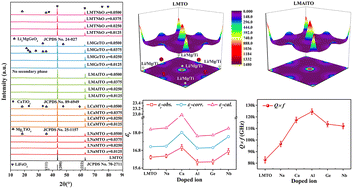
The development of high-performance microwave dielectric ceramics requires precise control of both intrinsic and extrinsic factors governing dielectric response. This work systematically investigates aliovalent ion doping (Na+, Ca2+, Al3+, Ge4+, Nb5+) in LiMg0.5Ti0.5O2 ceramics to establish composition-structure–property relationships. First-principles calculations reveal enhanced electron density in [Li/Ti/MgO6] octahedra across all doped systems, indicating improved polarization characteristics. Experimental results demonstrate that Al3+ doping achieves optimal performance by completely suppressing secondary phases, enhancing densification at reduced sintering temperature (1225 °C), and strengthening bond energy. The Al3+-modified ceramic exhibits superior properties: Q × f = 124 535 GHz, εr = 15.99, and τf = −20.5 ppm °C−1. Comparative analysis identifies the critical role of bond energy in controlling τf, while lattice vibration damping governs dielectric loss. This study not only identifies Al3+ as the optimal dopant for LiMg0.5Ti0.5O2 ceramics but also provides fundamental insights into designing thermally stable microwave materials through crystal chemistry engineering.
 Please wait while we load your content...


