


Mapping the structural evolution in supercooled polysiloxane liquids: a combined temperature-resolved WAXD and 2D-COS study
 *a
and
*a
and
Abstract
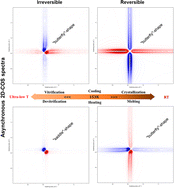
Understanding the structural evolution of deeply supercooled polymeric liquids remains a fundamental challenge in soft matter physics. Herein, we address this challenge by probing the glass transition and molecular dynamics of linear polydimethylsiloxane (PDMS) oligomers. Temperature-modulated differential scanning calorimetry (DSC) reveals that terminal groups exert a negligible influence on cryogenic crystallization, melting, and vitrification behavior. Furthermore, by integrating temperature-resolved wide-angle X-ray diffraction (WAXD) with two-dimensional correlation spectroscopy (2D-COS), we directly reveal hysteretic structural pathways during cooling and heating (38–153 K), manifested as distinct butterfly-shaped and saddle-shaped asynchronous patterns. We attribute this spectral asymmetry to an irreversible structural evolution driven by the competition between β-relaxation-mediated segmental motions and incipient α-relaxation-controlled long-range rearrangements near the glass transition temperature (Tg), thereby providing a molecular-level perspective on non-equilibrium dynamics in polymeric glasses.
 Please wait while we load your content...


