


Near-infrared light-emitting electrochemical cells based on a molecular ruby

Abstract
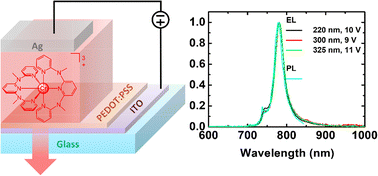
Near-infrared (NIR) light-emitting electrochemical cells (LECs) hold promise for low-cost, large-area, and flexible optoelectronic applications, yet efficient NIR emission from earth-abundant metal complexes remains challenging. Here, we report the fabrication and characterization of the first NIR LECs based on a cationic chromium(III) complex, [Cr(ddpd)2][BF4]3 (ddpd = N,N′-dimethyl-N,N′-dipyridine-2-ylpyridine-2,6-diamine). Neat-film devices exhibited spectrally stable and narrowband NIR EL emission (full width at half maximum (FWHM) = 27 nm), but their external quantum efficiency (EQE) remained low due to limited carrier balance. To address these limitations, a host–guest strategy was employed using a blue-green emissive cationic iridium(III) complex as the host. Although energy transfer from host to guest was inefficient, incorporation of the host significantly improved the carrier balance. The optimized host–guest device (220 nm) achieved a peak EQE of 1%, representing a ∼20-fold enhancement over the neat-film device. However, operational stability was constrained by the intrinsic instability of the Cr-based complex. Device thickness was found to significantly influence temporal evolution of EL spectra, residual host emission, and device efficiency. This work establishes a cationic chromium(III) complex as a promising sustainable NIR emitter for LEC devices and offers design strategies for high-efficiency, earth-abundant light-emitting devices.
 Please wait while we load your content...


