


 PLATFORM UPDATE:


Dually switchable lasing emission in a photonic crystal cavity with temperature and solvent responsiveness

Abstract
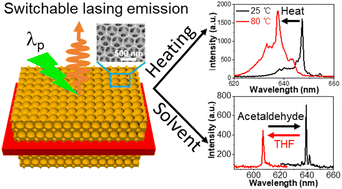
Tunable lasers can change lasing wavelength within a certain range and have potential applications in the fields of optical communication, spectral analysis, and medical equipment. Multiple tunable lasers based on responsive photonic crystals (RPCs) are particularly important due to their tunable lasing action under diverse external stimuli. Herein, we demonstrate dually switchable lasing emission in the PRC cavity under the stimuli of temperature and solvent. When the RPC cavity is heated from room temperature to 80 °C, lasing emission is tuned from 645.8 nm to 637.6 nm, owing to the blueshift of the stopband of the RPC from 631 nm to 611 nm. Moreover, reversible switching of lasing wavelength could be achieved by exposing the RPC cavity to different solvents. When the RPC cavity is exposed to 40% acetaldehyde, the lasing wavelength is switched from 607 nm to 639 nm with the change of the stopband from 581 nm to 628 nm. Notably, the lasing wavelength could return from 639 nm to 607 nm under further exposure to tetrahydrofuran, owing to the recovery of the stopband from 628 nm to 581 nm. The dually switchable lasing action is attributed to the fact that the lasing wavelength is always located at the low-energy bandedge in the RPC cavity due to the bandedge effect. This study provides a robust strategy to tune the lasing wavelength in the RPC cavity by the stimuli of temperature and solvent, which will be a perspective in the construction of multiple switchable organic solid-state lasers.
 Please wait while we load your content...


