


 PLATFORM UPDATE:


Wide-spectrum self-powered photoelectric detection based on the type-II heterostructure of MnPSe3/MoS2

Abstract
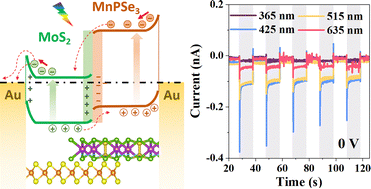
The call for a green economy has accelerated research and development of energy-saving optoelectronic devices. The choice of photoelectric material and the design of the device configuration are crucial for achieving high device performance. In this study, we investigated the photoelectric response behaviors of van der Waals (vdW) heterostructure photodetectors by employing a type-II MnPSe3/MoS2 heterojunction for charge carrier transport. Two types of device architecture were designed, one has a vertically stacked heterostructure with the photogenerated carriers transferring in an out-of-plane direction in the overlapped area of both materials; the other utilizes the photogating effect using the top MoS2 as the photogate for the carrier distribution modulation and MnPSe3 at the bottom as the carrier transport channel. Both PDs demonstrated a broadband photoelectric response in the range of 254–1020 nm under the biased condition. Additionally, the former device exhibited distinct self-powered behavior with a spectral detection range spanning from 365 nm to 635 nm, which was attributed to the higher charge carrier separation efficiency resulting from the built-in electric field of the MnPSe3/MoS2 heterojunction and the asymmetric barrier heights of the two metal–semiconductor interfaces. This study reveals the possibility of harnessing the vdW MnPSe3/MoS2 hybrid in low-power-consuming optoelectronic devices and its application potential in broadband photoelectric detection.
 Please wait while we load your content...


