Excited-state AIE material for differential recognition of toxic hair color ingredients: towards functional device applications

Abstract

We designed and synthesized an imino-linked dansyl-based molecule, DHNB, which exhibits interactions with the hair color ingredient p-phenylenediamine (PPD) and its oxidative trimer, Bandrowski's Base (BWB), over other analytes tested. Variable interactions, such as intra- and inter-molecular hydrogen bonding and environment-responsive conformational dynamics, were observed, leading to contrasting responses amongst the most responsive analytes. DHNB exhibits Excited State Intramolecular Proton Transfer (ESIPT)-assisted Aggregation-Induced Emission (AIE) in MeOH : H2O (10 : 90), which is utilized for the detection of hair color ingredients. The presence of BWB quenches the fluorescence emission of DHNB in MeOH : H2O (10 : 90) at 497 nm, whereas in the presence of PPD, the emission at 497 nm is quenched, with simultaneous appearance of a new blue shifted band at 402 nm. Importantly, the successful detection of PPD in a commercial hair color sample underscores the practical applicability of DHNB. Furthermore, variations in the charge transport properties of DHNB in MeOH : H2O (10 : 90) and upon interaction with BWB/PPD were observed via current–voltage (IV) measurements, suggesting its strong potential as an electrical sensor device.
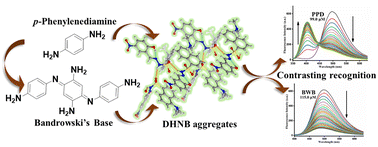
Graphical abstract: Excited-state AIE material for differential recognition of toxic hair color ingredients: towards functional device applications

Supplementary files

Article information

Article type
Paper
Submitted
06 Oct 2025
Accepted
17 Nov 2025
First published
01 Dec 2025
This article is Open Access
Creative Commons BY-NC license

J. Mater. Chem. C, 2026, Advance Article

Excited-state AIE material for differential recognition of toxic hair color ingredients: towards functional device applications

Shagun, D. Dhiman, D. Rambabu, K. Robeyns, R. Khosla and A. Dhir, J. Mater. Chem. C, 2026, Advance Article , DOI: 10.1039/D5TC03630E

This article is licensed under a Creative Commons Attribution-NonCommercial 3.0 Unported Licence. You can use material from this article in other publications, without requesting further permission from the RSC, provided that the correct acknowledgement is given and it is not used for commercial purposes.

To request permission to reproduce material from this article in a commercial publication, please go to the Copyright Clearance Center request page.

If you are an author contributing to an RSC publication, you do not need to request permission provided correct acknowledgement is given.

If you are the author of this article, you do not need to request permission to reproduce figures and diagrams provided correct acknowledgement is given. If you want to reproduce the whole article in a third-party commercial publication (excluding your thesis/dissertation for which permission is not required) please go to the Copyright Clearance Center request page.

Read more about how to correctly acknowledge RSC content.

Social activity

Spotlight

Advertisements