


 PLATFORM UPDATE:


Tailored thermally stable functionalization of CsPbBr3 nanocrystals for polymer nanocomposite scintillator fabrication
 *ab
Kateřina
Děcká,
a
Petr
Liška,
cd
Solangel Rojas
Torres,
a
Jan
Valenta,
e
Vladimir
Babin,
b
Ildefonso León
Monzón,
f
Václav
Čuba,
a
Eva
Mihóková
ab
and
Etiennette
Auffray
g
*ab
Kateřina
Děcká,
a
Petr
Liška,
cd
Solangel Rojas
Torres,
a
Jan
Valenta,
e
Vladimir
Babin,
b
Ildefonso León
Monzón,
f
Václav
Čuba,
a
Eva
Mihóková
ab
and
Etiennette
Auffray
g
Abstract
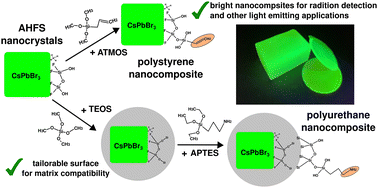
CsPbBr3 nanocomposites are prospective luminescent materials with great potential for many light-emitting applications. However, embedding CsPbBr3 nanocrystals into some potentially interesting matrices proves challenging in terms of maintaining their properties and good transparency of the final nanocomposite, e.g., high temperature polymerization of widely used and radiation-hard polystyrene or employment of more polar polymers such as polyurethanes often leads to nanocrystal degradation. Here, we present a functionalization strategy using ammonium hexafluorosilicate in combination with functional organosilanes for the fabrication of CsPbBr3 nanocomposites, which provides improved thermal stability of surface passivation up to 110 °C. Moreover, it enables for the first time concomitant surface modification to enhance compatibility between nanocrystals and the matrix, leading to improved transparency of nanocomposites. We demonstrate that the process can be tailored by preparing polystyrene (PS) and polyurethane (PU) nanocomposites. This opens the way for easier processability of popular high cure temperature polymers such as polystyrene, as well as for efficient embedding of NCs into novel matrices with the aim of exploiting crucial properties for desired applications, for example, radiation hardness or flexibility.
- This article is part of the themed collection: Novel materials and devices for photon and ionizing radiation detection
 Please wait while we load your content...


