


 PLATFORM UPDATE:


Nanopatterning optimization of zinc phosphide: hole mobility up to 560 cm2/V s with selective area epitaxy
 †*a
Thomas
Hagger,
a
Didem
Dede,
a
Valerio
Piazza,
a
Maria Chiara
Spadaro,
bcd
Jordi
Arbiol
be
and
Anna Fontcuberta i
Morral
*af
†*a
Thomas
Hagger,
a
Didem
Dede,
a
Valerio
Piazza,
a
Maria Chiara
Spadaro,
bcd
Jordi
Arbiol
be
and
Anna Fontcuberta i
Morral
*af
Abstract
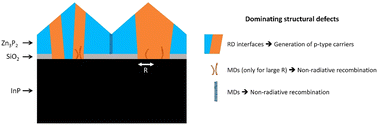
Zinc phosphide (Zn3P2) has been identified as a promising material for low-cost photovoltaics made of earth-abundant elements. In the 90's, the low performance of the devices based on Zn3P2 was attributed to the poor quality of the crystal. Recently, selective area epitaxy (SAE) has emerged as a method to obtain high quality materials on lattice mismatched substrates, thanks to efficient strain relaxation. Here, we study the relation between the SAE mask characteristics and the resulting optoelectronic properties of Zn3P2 thin films. Photoluminescence spectroscopy and temperature-dependent Hall measurements outline the impact of those defects on the optoelectronic properties of the thin films. We correlate the effect of the SAE mask pattern on the formation of specific defects such as misfit dislocations and rotated domains. Our results suggest that the rotated domains contribute to the carrier transport by providing p-type carriers while the misfit dislocations are mainly acting as non-radiative recombination centers. Our thickness dependent measurements highlight the key role of the SiO2/Zn3P2 interface, which could induce a highly p-doped region. Overall, these findings drove the optimization of the SAE pattern leading to the highest hole mobility (560 cm2/V s) ever measured for this material.
- This article is part of the themed collection: Journal of Materials Chemistry C HOT Papers
 Please wait while we load your content...


