


 PLATFORM UPDATE:

Achieving high field-effect mobility in CuSCN thin-film transistors with thiocyanate-functionalized polymers as fluorine-free dielectrics
 †a
Patipan
Sukpoonprom,
ad
Vinich
Promarak,
a
Nicola
Gasparini,
d
Daniel
Crespy
*a
and
Pichaya
Pattanasattayavong
*a
†a
Patipan
Sukpoonprom,
ad
Vinich
Promarak,
a
Nicola
Gasparini,
d
Daniel
Crespy
*a
and
Pichaya
Pattanasattayavong
*a
Abstract
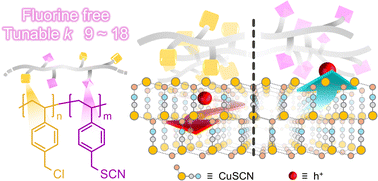
Interface engineering is crucial for optimizing interactions occurring upon contact of two different materials to produce electronic devices with high performance. Over the past few decades, copper(I) thiocyanate (CuSCN) has emerged as a promising hole transport material for a wide range of applications. Advances in understanding CuSCN interfaces have yielded significant improvement in photovoltaic properties and stability, being comparable to the state-of-the-art systems, through deeper insight into interfacial phenomena. While thin-film transistors (TFTs) were recognized as early applications of CuSCN in emerging technologies, CuSCN–dielectric interfaces – where charge transport occurs – have only been sparsely investigated. Herein, a series of functional copolymers with tunable dielectric properties were synthesized and employed as polymer dielectrics for CuSCN-based TFTs. A systematic increase of the dielectric constant and field-effect mobility was observed with an increased proportion of the thiocyanato (–SCN) functional group. Interestingly, TFTs with a purely SCN-functionalized polymer serving as a dielectric exhibited a promising mobility of 0.03 cm2 V−1 s−1. This value is remarkably comparable to that achieved using the CuSCN-compatible high-k fluorinated terpolymer P(VDF–TrFE–CFE), despite the latter possessing a dielectric constant that is three fold higher. This work emphasizes that chemical compatibility at the interface is essential for further development of fluorine-free CuSCN-based devices.
- This article is part of the themed collection: Celebrating International Women’s Day 2026: Women in Journal of Materials Chemistry C
 Please wait while we load your content...


