


Swelling-assisted embedding of metal nanowires into polymer substrates via roll-to-roll processing for enhanced mechanical durability
 *e
*e
Abstract
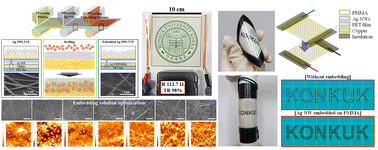
Flexible electrode conductors are essential components for the next generation of flexible electronics. Although ultrathin (<100 µm) silver nanowires (Ag Nws) are particularly suitable for multilayer optoelectronic devices, they are limited by low chemical and thermal stabilities. Current embedding techniques, proposed to overcome these limitations, involve complex or multi-step procedures that limit scalability. This study reports a high-throughput, large-area embedding process using a fully roll-to-roll (R2R) system to fabricate mechanically robust and transparent conductive films. Ag NWs and polymethylmethacrylate (PMMA) were used as conductive and embedding materials, respectively, with swelling-induced activation to enable efficient embedding. The continuous R2R process comprised three sequential steps: PMMA coating, Ag NW deposition, and application of the embedding-active agent. The optimal PMMA molecular weight, drying temperature, and embedding agent concentration for improving interfacial bonding and mechanical durability were determined. The resulting Ag NW-embedded flexible conductive films exhibited excellent electrical and optical performance, with a sheet resistance of 176.1 Ω sq−1 and an optical transmittance of 99% over a 100 cm2 area. The films also demonstrated superior durability under repeated bending, taping, and peeling, maintaining stable conductivity. Mechanical reliability was further validated by fabricating flexible touch screen panels that remained fully operational under continuous bending and could be conformally attached to curved surfaces, such as the wrist. The proposed fully-continuous R2R embedding strategy offers a scalable and reliable route for producing high-performance flexible electrodes suitable for wearable and large-area electronic applications.
 Please wait while we load your content...


