


 PLATFORM UPDATE:


Photo-modulation of the work function and electronic properties of MXenes via a self-assembled cationic azobenzene molecular layer
 *ac
and
Tao
Liu
*ac
*ac
and
Tao
Liu
*ac
Abstract
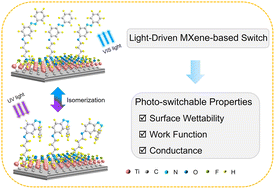
Modulating the electronic properties of 2D MXene-based devices through a rapid and noninvasive light methodology is highly demanded for advancing ultrathin electronic devices. In this study, we introduce a new method for optically modulating the electrical properties of Ti3C2Tx MXenes by non-covalent self-assembly of photochromic cationic azobenzene molecules (p-[2-(2-hydroxyethyldimethylammonio)ethoxy]azobenzene, AZ+Br−). The functionalization of the self-assembled layers was confirmed through a suite of optical and spectroscopic analyses. The self-assembled molecular layer facilitated efficient photo-switching between the trans and cis isomeric states upon sequential UV and visible light irradiation. The trans-to-cis photoisomerization induced reversible modulations of the electrical conductivity of Ti3C2Tx MXenes, resulting in a photocurrent switching amplitude of ∼49% under alternating light stimuli. Furthermore, Kelvin probe force microscopy (KPFM) revealed a substantial variation in the work function, exhibiting an adjustable window of approximately 70 meV between the two isomeric states. The modulations of work function and electrical conductivity were repeatable over multiple irradiation cycles without detectable degradation, demonstrating robust switching performance. Structural analyses revealed that these photo-switchable properties were attributed to the distinct differences in dipole moments between the trans and cis isomers. These findings demonstrate a viable strategy for designing novel MXene-based electronic devices with tunable optoelectronic properties.
 Please wait while we load your content...


