


 PLATFORM UPDATE:


Crystallographically altered (Mg,Sr)3(Al,Ga)2GeO8:Cr3+ phosphors with tuned emission width from the ultra-sharp red to profound NIR band

Abstract
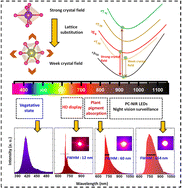
Deep red to near-infrared (NIR) phosphors with extraordinary emission intensity, variable peak wavelength, and emission width are in great demand for smart next-generation lighting applications. Nonetheless, incorporating such features in any phosphor system is extremely difficult. Herein, a new Mg3Al2GeO8:0.01Cr3+ phosphor with ultra-sharp emission band peaking at 693 nm with a full-width at half maximum (FWHM) of ∼4 nm has been initially developed. The emission intensity and the FWHM of the phosphor have been increased by substituting alkaline earth metal ions. The optimum Mg2.9Al2GeO8:0.01Cr3+,0.1Sr2+ exhibits emission intensity that is three times greater than that for the Mg3Al2GeO8:0.01Cr3+ sample. The additional [MgO6] sites from the newly generated Sr impurity phase and the structural distortion in the Cr3+-occupied sites are responsible for the emission enhancement. In addition, Ga3+ co-doped Mg2.9(Al2−yGay)GeO8:0.01Cr3+,0.1Sr2+ samples have been developed and the crystal field environment is weakened in [GaO6] that is occupied by Cr3+ ions. The emission from the multiple sites with strong and weak crystal field environments resulted in a broadband emission (630 nm to 1050 nm and an FWHM of ∼150 nm), effectively covering the first biological window region. The pc-LED produced by combining the 410 nm LED with the Mg2.9Al2GeO8:0.01Cr3+,0.1Sr2+ phosphor with 100% color purity can be used for display application. Meanwhile, the 410-nm LED combined with the Mg2.9(AlGa)GeO8:0.01Cr3+,0.1Sr2+ phosphor exhibits the potential for plant growth applications. Moreover, the NIR LEDs produced from the Mg2.9(Al0.5Ga1.5)GeO8:0.01Cr3+,0.1Sr2+ phosphor find application in night vision surveillance. Finally, the synthesized phosphor is utilized for in vitro cellular imaging, as demonstrated in cervical cancer HeLa cells.
 Please wait while we load your content...


