


 PLATFORM UPDATE:


Optoelectronic inhibitory synapses in the visible range from PbS nanocrystal arrays

Abstract
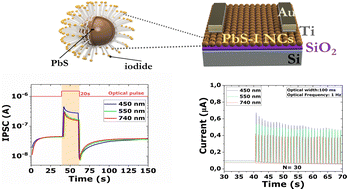
Optoelectronic inhibitory synapses play critical roles in modulating neural activity and maintaining the balance between excitation and inhibition within artificial neural circuits. However, most reported devices fail to properly emulate depression-related synaptic functions under optical stimulation. In this work, we demonstrate an optoelectronic inhibitory synaptic device based on lead sulfide (PbS) nanocrystals capped with iodide ligands. Crucially, the devices operate in the visible range (RGB), essential for retina-inspired color sensing, demonstrating inhibitory postsynaptic current (IPSC) behavior under 450, 550 and 740 nm illumination. A low power consumption of ∼40 nJ was also recorded under red light illumination. The system successfully emulates fundamental synaptic behaviors including paired-pulse depression (PPD), spiking-number-dependent plasticity (SNDP), and spiking-rate-dependent plasticity (SRDP), enabling biologically plausible visual processing.
 Please wait while we load your content...


