


 PLATFORM UPDATE:


Recent advances in synthesis of ZnCr2O4 nanomaterials and their composites for catalytic, energy, sensing, and biomedical applications: a review
 b
Majid S.
Jabir,
c
Kar Ban
Tan,
d
Deepak
Kumar,
g
Abbas
Rahdar
h
and
Suresh
Ghotekar
*b
b
Majid S.
Jabir,
c
Kar Ban
Tan,
d
Deepak
Kumar,
g
Abbas
Rahdar
h
and
Suresh
Ghotekar
*b
Abstract
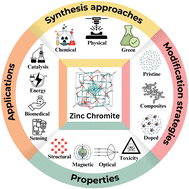
Zinc chromite nanoparticles (ZnCr2O4 NPs) have emerged as a multifunctional class of spinel oxides exhibiting remarkable physicochemical, magnetic, optical, electrical, and catalytic/photocatalytic properties, which make them promising candidates for a wide range of technological and biomedical applications. The structure–property–application linkages of ZnCr2O4 nanomaterials (NMs) have not been thoroughly evaluated or correlated, despite a great deal of research on spinel ferrites. This review provides a comprehensive and comparative overview of recent advancements in synthetic strategies—including sol–gel, hydrothermal, co-precipitation, microwave-assisted, solvothermal, combustion, and green synthesis methods—and how key reaction parameters—such as pH, precursor concentration, solvent, temperature, and time—influence morphology and performance. The prominent features of ZnCr2O4 NPs include outstanding photocatalytic and catalytic activity, tunable morphology, and excellent stability. Special emphasis is placed on linking intrinsic properties such as surface area, bandgap, redox potential, and magnetic behavior to their diverse applications in photocatalysis, energy storage, sensing, and biomedical fields. In this regard, we have reviewed the current literature and discussed the physicochemical characteristics, fabrication methods, and possible uses of newly developed ZnCr2O4 NMs. Unlike previous evaluations, this work highlights the excellent stability, adjustable morphology, and multifunctionality of ZnCr2O4-based systems by objectively comparing them with other spinel oxides. Additionally, the diverse applications of ZnCr2O4 NMs are explored, along with potential directions for future research. The novelty of this review lies in its integrated discussion of property-driven design principles, offering a comprehensive perspective that may guide the future optimization of ZnCr2O4 NMs for sustainable technological and biomedical applications.
- This article is part of the themed collection: Journal of Materials Chemistry C Recent Review Articles
 Please wait while we load your content...


