


 PLATFORM UPDATE:


Partially self-healing flexible light-emitting diodes based on InGaN/GaN microwires
 a
Diana E.
Kolesina,
a
Anna S.
Miroshnichenko,
b
Konstantin V.
Deriabin,
b
Akanksha
Kapoor,
c
Joël
Eymery,
e
Christophe
Durand,
c
Maria
Tchernycheva,
f
Regina M.
Islamova
*b
a
Diana E.
Kolesina,
a
Anna S.
Miroshnichenko,
b
Konstantin V.
Deriabin,
b
Akanksha
Kapoor,
c
Joël
Eymery,
e
Christophe
Durand,
c
Maria
Tchernycheva,
f
Regina M.
Islamova
*b
Abstract
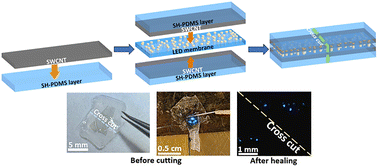
Self-healing materials are promising for novel applications in next-generation displays. In this study, the first implementation of self-healing light-emitting devices based on an array of III–nitride microwires is demonstrated. The novel design integrates blue-emitting core–shell InGaN/GaN microwires embedded in a typical polydimethylsiloxane matrix with flexible electrodes. The electrodes are composed of aerosol-deposited single-walled carbon nanotube pads on a self-healing silicone based on “siloxane equilibrium”. Self-healing light-emitting diodes are able to partially restore their functionality after full mechanical damage (cross-cut) in terms of electrical and light-emitting properties. Additionally, the electrical stability is confirmed by bending tests of the self-healing electrode and device as well: the SWCNT-based electrode healed at 100 °C remains stable at ≈3.1 mA up to 1000 cycles, which confirmed its mechanical stability under cyclic bending. Such damage-resilient LEDs represent a significant step towards robust and long-lasting flexible optoelectronic devices that are resistant to mechanical impacts.
 Please wait while we load your content...


