


 PLATFORM UPDATE:


Magneto-optical Raman effect of WS2 tuned by a plasmonic gold nanograting

Abstract
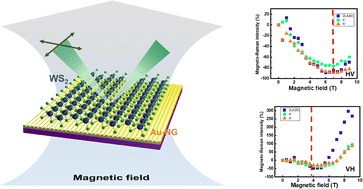
In recent years, the magento-optical properties of two-dimensional transition metal dichalcogenides (TMDCs) have garnered significant attention from scholars, owing to their potential applications in spintronic and valleytronic devices. Hybridizing TMDCs with plasmonic nanostructures has been demonstrated to be an effective route to modulate the optical properties of TMDCs. In this study, the modulation effects of a plasmonic Au nanograting (Au-NG) on the magneto-optical properties of monolayer WS2 were systematically investigated utilizing polarized-Raman spectroscopy. Raman modes of WS2 exhibited regular intensity fluctuation with increasing magnetic fields. It is worth noting that the magnetic-field-dependent Raman intensity of WS2 on Au-NG exhibited obvious differences from WS2 on Si and Au films, of which the critical magnetic field was 5.5 T in both the parallel and crossed polarization configurations. The critical magnetic field was promoted to 6.5 T when laser polarization was perpendicular to Au-NG. Even more attractively, the critical magnetic field was lowered to 3.5 T when the laser polarization was parallel to Au-NG. This phenomenon can be attributed to the localized surface plasmonic resonance effect from Au-NG, leading to the opposite electric field response under different polarizations. This work not only deepens the understanding of the magento-optical properties of WS2, but also offers a useful new approach for designing high-sensitivity magneto-optic devices based on WS2.
 Please wait while we load your content...


