


 PLATFORM UPDATE:


Realization of a high Chern number quantum anomalous Hall effect in ferromagnetic monolayer NiAl2Se4 from the 120° antiferromagnetic state via doping and strain regulations

Abstract
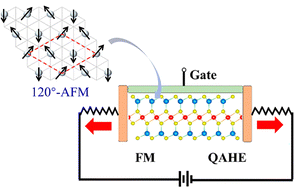
Topological insulators with tunable properties have emerged as promising candidates for exploring exotic physical phenomena and innovating topological spintronic devices. Here, we predict a monolayer NiAl2Se4 using first-principles calculations and the dynamical, thermal, and mechanical stabilities are systematically evaluated. The monolayer NiAl2Se4 exhibits a noncollinear 120° antiferromagnetic ground state with an indirect band gap of 1.23 eV, which remains robust under various strains and U values. Through hole-doping in monolayer NiAl2Se4, the antiferromagnetic state could change to a ferromagnetic state. Intriguingly, the ferromagnetic monolayer NiAl2Se4 with 1.0 hole-doping per unit cell and 8.5% tensile strain exhibits topological band structures, hosting the quantum anomalous Hall effect with a high Chern number of C = 2. The Chern number originates from the Berry curvatures around both the non-Dirac Γ point and Dirac K/K′ points. These findings highlight the potential of monolayer NiAl2Se4 for applications in topological spintronics.
 Please wait while we load your content...


