


 PLATFORM UPDATE:


Tunable electrochemical doping and charge transport in non-OMIEC:OMIEC blends by microstructure design

Abstract
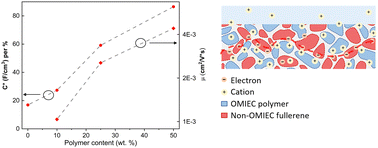
Organic mixed ionic–electronic conductors (OMIECs) are essential for applications such as organic electrochemical transistors (OECTs), yet inherent structural trade-offs limit the balance between ionic and electronic transport. Here, we demonstrate a microstructure-driven approach to induce and tune mixed conduction in a non-OMIECn-type fullerene by blending it with a p-type OMIEC polymer. Through systematic variation of blend composition and thermal annealing, we control the blend microstructure and phase separation, gradually transforming the n-type from a purely electron-transporting material into a functional n-type OMIEC. Electrochemical and microstructural analyses reveal that the operating n-type OECT mechanism is enabled by the formation of ion transport pathways by the hydrophilic p-type OMIEC polymer, which mediates the electrochemical doping of the fullerene at polymer:fullerene interfaces. These interfaces are also key for charge transport through the fullerene domains, implying that both electrochemical doping and electron mobility of the fullerene are critically governed by the blend microstructure. Optimal OECT n-type performance is observed for a bulk heterojunction microstructure blend with finely intermixed domains where polymer:fullerene interfaces are maximized, while maintaining continuous pathways for both ionic and electronic carriers in both polarities. Our findings demonstrate that microstructure engineering in blends can enable and control mixed conduction in non-OMIEC materials, offering a synthesis-free and versatile strategy for OMIEC development and integration in OECTs and related bioelectronic platforms.
 Please wait while we load your content...


