


 PLATFORM UPDATE:


Prediction of the elastic properties and electrical resistance of halide glass based on interpretable machine learning
 *ab
*ab
Abstract
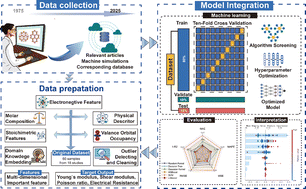
Halide glass is indispensable for high-end optoelectronic devices because of its unique photoelectric properties. Its elastic modulus and electrical resistance directly determine the mechanical reliability and signal integrity of these devices. However, conventional experimental fabrication and testing methods cannot establish an accurate structure–property relationship. Halide glass is highly susceptible to moisture and crystallization. Microcracks, porosity, and surface roughness markedly degrade its optoelectronic performance. To overcome these challenges, this study builds interpretable machine-learning models that rely solely on chemical composition and elemental physicochemical descriptors. The experimental data were preprocessed using the sine cosine algorithm (SAC) for feature selection and generative adversarial networks (GAN) for data augmentation, establishing a dataset for predicting the elastic properties and electrical resistance of halide glasses. The study evaluated the performance of six traditional machine learning algorithms and four deep learning and neural network algorithms across different task dimensions, achieving good predictive results. Among them, random forest achieved the best performance for the prediction of Young's modulus (R2 = 0.96146). Support vector machine excelled for the prediction of shear modulus (R2 = 0.95129). Decision tree led for the prediction of Poisson's ratio (R2 = 0.96783). The ensemble learning algorithms (LSBoost and XGBoost) performed well (R2 > 0.9) for the prediction of resistivity at different temperatures, while the BP neural network achieved good results across six distinct tasks (R2 > 0.83). The proposed composition-only design strategy offers direct guidance for developing new halide glasses and for computer-aided inverse design.
 Please wait while we load your content...


