


 PLATFORM UPDATE:


Pursuing red thermally activated delayed fluorescence upon increasing the degree of branching in phenothiazine-trithienyltriazine push–pull compounds
 *b
and
Benedetta
Carlotti
*a
*b
and
Benedetta
Carlotti
*a
Abstract
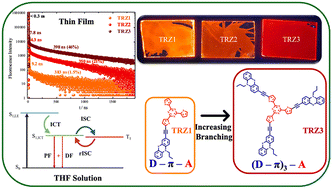
In this study, three new push–pull compounds bearing phenothiazine as the electron donor and trithienyltriazine as the electron acceptor connected by triple bond π-bridges and arranged in dipolar (TRZ1), quadrupolar (TRZ2) and octupolar (TRZ3) molecular structures were designed and synthesized. The efficiencies and rates of their excited state deactivation pathways, strongly modulated by the environment, were unveiled through advanced time resolved spectroscopies with nanosecond and femtosecond temporal resolution. Highly efficient fluorescence and intersystem crossing were found to occur in non polar solvents, which justify all the absorbed quanta. Emission measurements in a non polar rigid matrix at low temperature uncovered small singlet-to-triplet energy gaps for these molecules. Indeed, in fairly polar media, an intramolecular charge transfer state quasi-isoenergetic to the triplet excited state was stabilized and populated, resulting in reverse intersystem crossing followed by orange/red delayed fluorescence. Similarly, delayed fluorescence was clearly detected in thin films of TRZ1–3 at room temperature. Upon increasing the degree of branching among the molecules in this series, the emission color in the solid state was turned from orange to deep red and the amplitude of the delayed component was largely enhanced. The mechanistic reason underlying this behavior could be found in the relatively faster intersystem crossing than prompt fluorescence in the multi-branched compounds. Our results demonstrate the positive role played by the degree of branching in boosting red delayed fluorescence in all-organic materials for applications in third generation organic light emitting diodes.
 Please wait while we load your content...


