


 PLATFORM UPDATE:


Enhancing high-temperature energy density of dielectric composites by tailoring molecular semiconductors

Abstract
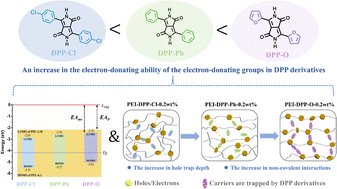
To overcome the challenge where the exponential increase in leakage current of aromatic dielectric polymers under high-temperature and high-electric-field conditions leads to a mutual constraint between capacitive performance and thermal stability, in this study, diketopyrrolopyrrole derivatives (DPP-X, X = Cl, Ph, and O) with different electron-donating groups were doped into the PEI matrix. Based on the differences in the electron-donating ability of these electron-donating groups, the depth of charge carrier (electron and hole) traps in the PEI-DPP-X (X = Cl, Ph, and O) composite materials, as well as the strength of hydrogen bonding and electrostatic interactions between DPP-X (X = Cl, Ph, and O) and the PEI matrix, can be optimized—ultimately achieving an improvement in their high-temperature capacitive energy storage performance. As a result, DPP-O, with the strongest electron-donating ability, constructs deeper hole traps. At 200 °C, compared with pure PEI, the leakage current of PEI-DPP-O (0.2 wt%) is reduced by 3.37 times. Meanwhile, due to the strong electron-donating groups of DPP-O, it forms a more robust physical crosslinking network with the PEI matrix through hydrogen bonding and electrostatic interactions, enhancing the mechanical strength and breakdown strength (Eb). This synergistic regulation mechanism achieves the joint enhancement of electrical insulation and heat resistance of composites, enabling PEI-DPP-O-0.2 wt% composites to achieve excellent energy storage densities of 5.64 J cm−3 and 3.98 J cm−3 at 150 °C and 200 °C (η = 90%), respectively, outperforming lots of reported dielectric composites. In addition, the excellent cycling stability, the ability to prepare large-area high-quality uniform thin films, and the ultra-low filler loading characteristics further confirm the potential application of dielectric composites through molecular structure level regulation under extreme conditions.
 Please wait while we load your content...


