


 PLATFORM UPDATE:


Multiphase conduction and piezoelectric properties of 2D (GA)2PbI4 Ruddlesden–Popper perovskites for energy harvesting applications

Abstract
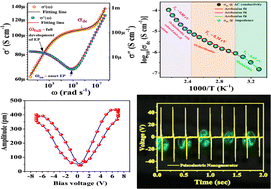
In this work, we studied the dielectric and piezoelectric properties of mechanochemically synthesized double-layered and two-dimensional guanidinium-lead iodide [(GA)2PbI4] Ruddlesden–Popper halide perovskites for energy harvesting. We adopted complex impedance spectroscopy, complex conductivity and complex electric modulus formalisms to understand the charge carrier dynamics and relaxation mechanisms. We employed different models, such as the Maxwell–Wagner equivalent circuit model, the universal power law coupled with a modified Poisson–Nernst–Planck (PNP) model, Havrilliak–Negami (HN) and Kohlrausch–Williams–Watts (KWW) models to analyse the experimental data measured in wide temperature (303 ≤ T ≤ 463 K) and frequency (4 Hz ≤ƒ≤ 8 MHz) ranges. Two calorimetric anomalies at T1 = 307 K and T2 = 356 K are observed in the DSC trace. The dc conductivity (σdc) show distinct Arrhenius behaviour with distinct activation energies in three temperature regions: 0.63 eV (±0.02) for region-I (303–323 K), 0.34 eV (±0.01) for region-II (333–383 K) and 0.80 eV (±0.02) for region-III (393–463 K). These activation energies are associated with the phase transition of the (GA)2PbI4 perovskite from the monoclinic to orthorhombic phase and another continuous phase transition to orthorhombic with reduced unit cell volume. The hopping frequency and relaxation time also show Arrhenius behaviour with activation energies similar to the dc conductivity in the same temperature regions. Three distinct conduction mechanisms are predicted in these three temperature regions. The conduction mechanisms change from correlated barrier hopping (region-I) to non-overlapping small polarons hopping (region-II) and then to correlated barrier hopping (region-III) again. In addition, we have measured the piezoelectric coefficient value (d33) of about 38 pm V−1 at the maximum applied bias voltage of 7.0 V and prepared a polyvinylidene fluoride (PVDF)-3 wt% (GA)2PbI4 perovskite composite film for demonstrating an energy-harvesting nanogenerator which delivered a maximum output voltage of 50.0 V and a current of 7.0 µA under hammering conditions.
 Please wait while we load your content...


