


 PLATFORM UPDATE:


On the photothermal behaviour of naphthalene diimide aggregates in water

Abstract
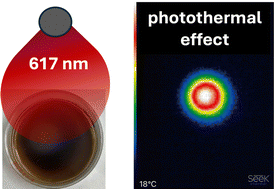
Photothermal effects, driven by the conversion of light into heat, offer versatile applications in fields such as photothermal therapy, energy conversion, and pollution degradation. Naphthalene diimide (NDI) molecules exhibit diverse properties with applications spanning optoelectronics, materials science, and nanomedicine. In this study, we synthesize various amino acid-functionalized naphthalene diimides, which, after irradiation with light in both gel and solution forms, produce radical anions, which enables their photothermal properties. Our findings demonstrate the influence of pH on photothermal performance. Furthermore, we demonstrate that the incorporation of polyvinyl alcohol (PVA) increases the viscosity of the solutions and reduces oxidation. To further investigate how pH affects the aggregated structures, we use small-angle neutron scattering (SANS). In addition, in situ SANS measurements were conducted to monitor the aggregation changes during irradiation to advance our understanding of NDIs’ potential as photothermal materials in potential energy-related applications.
 Please wait while we load your content...


