


 PLATFORM UPDATE:


Synergistic bimetallic PtPd catalysts supported on Zn2SnO4/SnO2 nanocubes for improved formaldehyde gas-sensing performance

Abstract
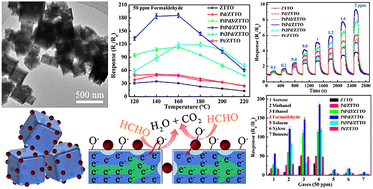
The utilization of bimetallic catalysts to decorate metal oxide semiconductors (MOSs) has emerged as a promising strategy for developing high-performance gas sensors. In this study, Zn2SnO4/SnO2 nanocubes (ZTTO NCs) were synthesized using a hydrothermal approach and subsequently decorated with bimetallic PtPd nanoparticles (1 wt% total loading) via a mild ascorbic acid reduction process. The PtPd catalysts supported on the surface of ZTTO NCs exhibit a coexistence of metallic and oxidized Pt–Pd components. Gas-sensing tests reveal that adjusting the Pt/Pd mass ratio significantly improves formaldehyde sensing performance. Notably, the sensor with an optimized Pt/Pd mass ratio of 1 : 1 demonstrates remarkable detection capabilities at 160 °C, characterized by a high response (Ra/Rg = 185.7 at 50 ppm), an ultralow limit of detection (11 ppb), and long-term stability. The improved formaldehyde sensing performance can be attributed to the synergistic catalytic effect arising from chemical sensitization induced by metallic PtPd and electronic sensitization mediated by PdO/PtO. This study provides fundamental insights into the gas-sensing mechanisms of MOS materials decorated with bimetallic catalysts.
 Please wait while we load your content...


