


 PLATFORM UPDATE:


Antipolar and short- and long-range magnetic ordering in quasi-two-dimensional AgCrP2S6
 *a
Atul G.
Chakkar,
a
Shantanu
Semwal,
b
Sebastian
Selter,
c
Yuliia
Shemerliuk,
c
Bernd
Büchner,
cd
Saicharan
Aswartham,
c
Koushik
Pal
b
and
Pradeep
Kumar
*a
*a
Atul G.
Chakkar,
a
Shantanu
Semwal,
b
Sebastian
Selter,
c
Yuliia
Shemerliuk,
c
Bernd
Büchner,
cd
Saicharan
Aswartham,
c
Koushik
Pal
b
and
Pradeep
Kumar
*a
Abstract
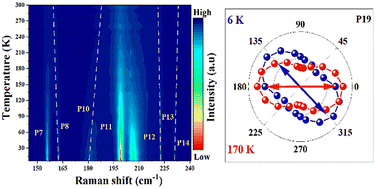
AgCrP2S6 serves as a versatile system to probe dynamics of the quasiparticle excitations as well as multiple phase transitions with lowering temperature linked with the polar, lattice and spin degrees of freedom. Here, we report in-depth temperature- and polarization-dependent Raman scattering measurements on single crystals of quasi-2D zigzag antiferromagnetic AgCrP2S6, along with first principles-based phonon calculations. We observed multiple phase transitions triggered by the short- and long-range ordering of spins at ∼90 K and 20 K, respectively, within the Cr sublattice, where spins are arranged in a 1D chain, as evident from the distinct anomalies in the phonon-mode self-energy parameters and intensity. Contrary to the conventional belief, we proposed the possibility of quasi-antipolar ordering at ∼200 K and with further lowering in temperature an antipolar ordering at ∼140 K attributed to the Ag ions, which is conjectured to be forbidden owing to the heaviness of Ag ions. The quasi-antipolar and antipolar orderings are gauged via a distinct renormalization of the parameters of phonons, which exist at all the temperatures. Additionally, a large number of modes appeared with the decrease in temperature, in the range of ∼200–140 K, where antipolar ordering started settling in. The emergence of a large number of phonon modes below ∼200 K, nearly double that at room temperature, suggests the lowering of symmetry from high-temperature C2h to low-temperature C2 or Cs.
- This article is part of the themed collection: Celebrating International Women’s Day 2026: Women in Journal of Materials Chemistry C
 Please wait while we load your content...


