


 PLATFORM UPDATE:


Exploring the gas-sensing properties at room-temperature and electrical behavior of oxalyldihydrazide-derived molybdenum complexes

Abstract
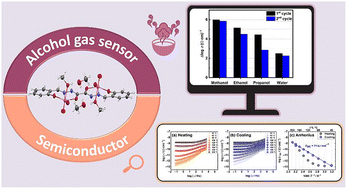
This study reports the design, synthesis, characterization, and performance evaluation of novel semiconductive molybdenum coordination complexes derived from an oxalyldihydrazide-based ligand. The ligand H4L was synthesized through the reaction of salicylaldehyde with oxalyldihydrazide, followed by coordination with a molybdenum metal center. From methanol solution, a dinuclear complex, [Mo2O4(L)(MeOH)2]·2H2O, was isolated, while a polynuclear complex of the formula [Mo2O4(L)]n was obtained from ethanol, acetonitrile, or acetone. These complexes were characterized using spectroscopic techniques and elemental analysis, and their thermal stabilities were assessed using thermogravimetric analysis. Density functional theory calculations were used to further assess the structural properties. The crystal and molecular structures of [Mo2O4(L)(MeOH)2]·2MeOH were determined through single-crystal X-ray diffraction. Notably, the materials exhibited moderate DC conductivity of 4.27 × 10⁻⁸ Ω−1 cm−1 for [Mo2O4(L)]n and 1.59 × 10⁻⁹ Ω−1 cm−1 for [Mo2O4(L)(MeOH)2]·2H2O@200 °C. [Mo2O4(L)(MeOH)2]·2H2O demonstrated potential applicability for the detection of volatile organic compounds (VOCs), including MeOH, EtOH, and PrOH, as well as H2O. Specifically, exposure to MeOH led to a six-order magnitude increase in conductivity, highlighting its high sensitivity. Exposure to EtOH resulted in a five-order magnitude increase, whereas exposure to PrOH led to a four-and-a-half-order magnitude increase in conductivity. Further optimization of the experimental setup enabled reproducible response cycles upon exposure of the material to methanol vapor. Moreover, the response time for MeOH detection was as low as 40 s, with a recovery time of 230 s, indicating high sensing efficiency at RT.
 Please wait while we load your content...


